
Sahil Yadav is a senior director of product management at Applied Optoelectronics Solutions, Inc. and a recognized expert in AI-driven infrastructure. He has led the development of autonomous systems for Fortune 500 companies as well as government clients. With deep expertise in ML, telemetry, and network resilience, Sahil builds self-healing and compliant AI architectures across cloud, edge, and on-prem environments for predictive maintenance and infrastructure monitoring. A senior IEEE member, he is a frequent conference speaker, blog author, and media contributor.
What AI Actually Needs Before It Can Run the Network
Artificial intelligence is a defining theme in broadband network operations. At this year's SCTE TechExpo, operationalizing AI at scale is a key topic to be addressed and an important one.
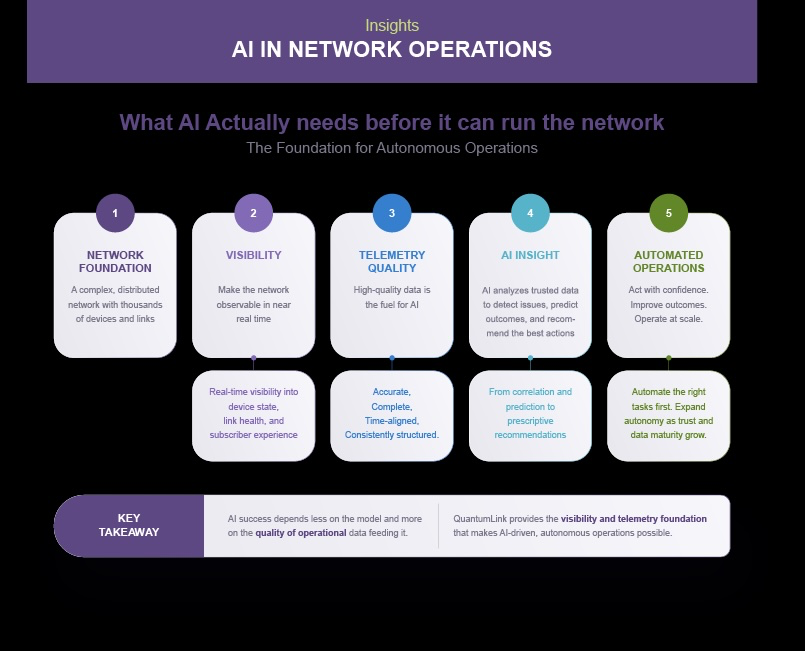
As operators move beyond AI pilots toward production deployments, the conversation is changing. Success depends less on the sophistication of the AI model and more on the quality of the operational data feeding it.
Sahil Yadav, Senior Director of Product Management for Quantum Bandwidth at AOI, speaks about why network visibility has become the foundation for autonomous operations.
Q: Everyone is talking about AI in network operations. What's changed over the past year?
A: A year ago, most operators were experimenting, including proofs of concept, isolated use cases, and a lot of enthusiasm. Today, the conversation is about production: what it takes to run AI continuously against a live network. That shift has moved the hard questions away from the model itself and toward the data and operational readiness underneath it.
Q: Is developing the AI actually the hardest part?
A: Not necessarily. Capable models are widely available, and the algorithms are relatively mature for many use cases. The harder part is feeding those models accurate, timely, well-structured data from the network, and building the operational trust to act on what they produce.
Q: Why does network visibility become so important?
A: You can’t automate what you can’t see. Visibility is what turns a network into something an AI system can reason about, with device state, link health, and subscriber experience observable in near real time. Without that foundation, AI is making decisions based on assumptions rather than evidence.
Q: How does telemetry quality affect AI performance?
A: Directly, and it’s not just about how much data you have. Incorrect data can be especially dangerous. A mislabeled device, stale reading, or miscalibrated sensor can lead a model to produce confidently wrong conclusions without making the underlying data problem obvious.
Missing data creates a similar challenge. Gaps in a time series can distort the baseline a model learns, making it harder to distinguish real degradation from normal variation. Sparse, delayed, or inconsistent feeds compound the problem.
What AI actually needs is telemetry that is accurate, complete, time-aligned, and consistently structured. That combination helps a model distinguish a genuine problem from normal variation, and the difference between a useful alert and noise that operators learn to ignore.
Q: During major network upgrades, why does telemetry matter even more?
A: Upgrades are when the network can be least predictable and the cost of a mistake is highest. Good telemetry gives you a clear before-and-after baseline, so you can confirm that a change delivered what it promised and catch regressions before subscribers do. It also shortens the troubleshooting window when something goes wrong.
Q: Where should operators automate first?
A: Start with high-volume, low-risk work, such as data collection, correlation, triage, and root-cause narrowing. Those tasks consume enormous operator time and are well suited to automation, so they can help build confidence quickly. Closed-loop remediation should come later, once the telemetry is proven.
Q: Where does QuantumLink fit into this evolution?
A: QuantumLink is the visibility layer that helps make the rest of it possible and purpose-built for HFC networks. It delivers the granular, real-time telemetry from the HFC plant that AI systems need in a form they can consume.
Just as importantly, it houses the AI module itself, so analytics can run on the same platform that collects the data rather than in a separate stack bolted on afterward. That keeps the loop tight: accurate HFC telemetry in, actionable insight out, and on one foundation operators can use to build their automation strategy.
Q: What do you expect operators will be discussing at SCTE TechExpo?
A: I expect a lot less talk about models and a lot more about the work underneath them—data readiness, integration, and operational trust. As the industry moves beyond early pilots, the interesting conversations will be about what operators have learned trying to move from proof of concept to production, including what didn’t work and why.
I also expect real debate about how much autonomy operators are willing to grant. Most teams are comfortable letting AI observe, correlate, and recommend, but far fewer are ready to let it act on the network unsupervised.
There will likely be a lot of discussion about scale. A model that performs well in one region or on one vendor’s equipment doesn’t automatically translate across a national footprint. The operators making the most progress are the ones investing in visibility first, and I think that will come through clearly in conversations on the show floor.