Sahil Yadav is a senior director of product management at Applied Optoelectronics Solutions, Inc. and a recognized expert in AI-driven infrastructure. He has led the development of autonomous systems for Fortune 500 companies as well as government clients. With deep expertise in ML, telemetry, and network resilience, Sahil builds self-healing and compliant AI architectures across cloud, edge, and on-prem environments for predictive maintenance and infrastructure monitoring. A senior IEEE member, he is a frequent conference speaker, blog author, and media contributor.
Why AI Guardrails Matter in Autonomous Broadband Networks

By Sahil Yadav, Sr. Director of Product Management, Quantum Bandwidth, AOI
AI has become the headline in nearly every technology conversation, and broadband infrastructure is no exception. Operators are asking smarter questions, vendors are building more intelligent platforms, and the industry is moving steadily toward autonomous network operations.
Unlike consumer AI tools, network AI interacts directly with physical infrastructure, customer experience, and critical communications systems. A hallucinated chatbot response is inconvenient. A hallucinated network action can impact thousands of subscribers.
That’s why the future of AI in broadband won’t be defined solely by better algorithms. It will be defined by the quality of the guardrails surrounding them.
The Shift Toward Autonomous Network Operations
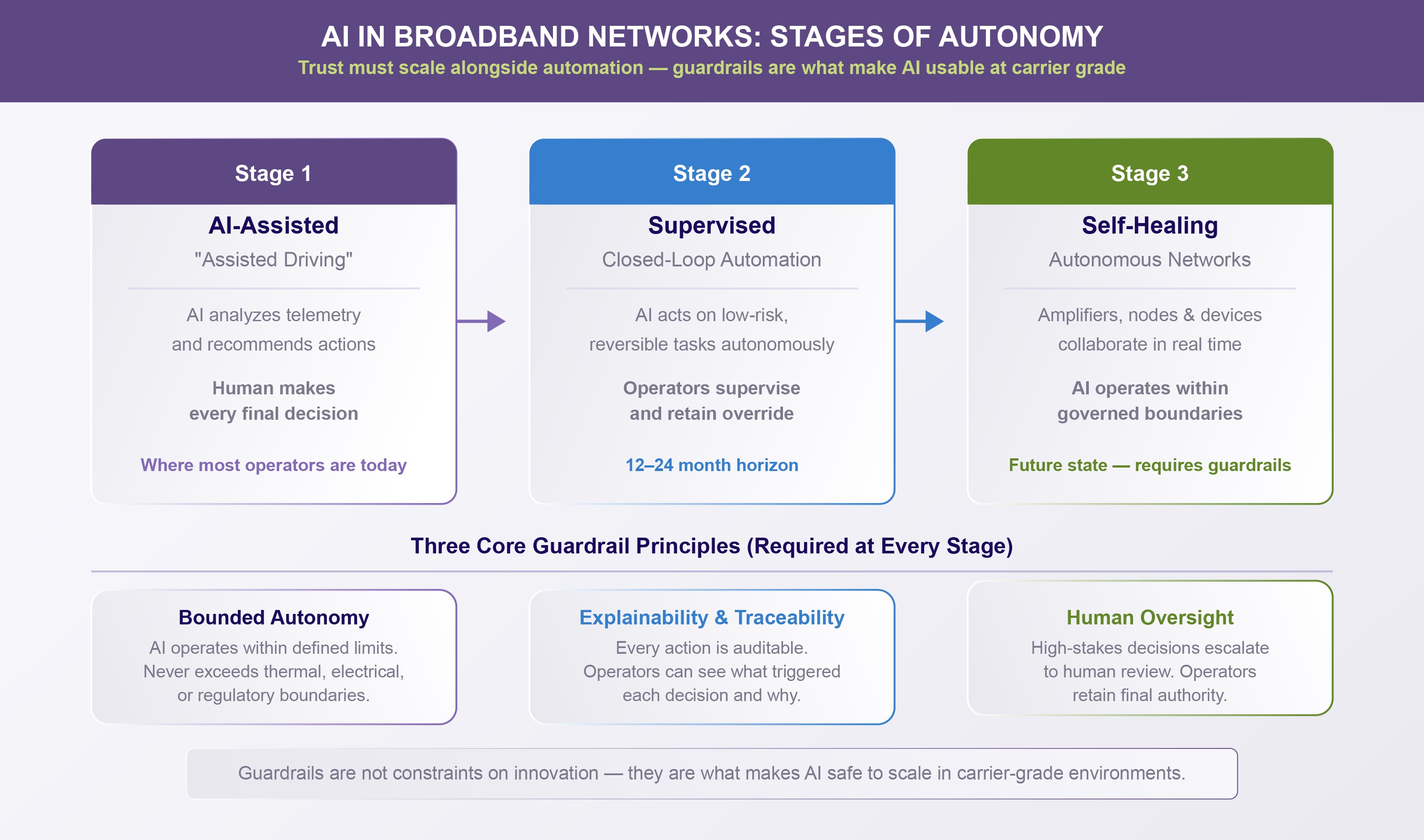
Today, most AI deployments in outside plant environments operate in what I’d call the “assisted driving” stage. AI analyzes telemetry, detects anomalies, predicts failures, and recommends corrective actions; but humans still make the final call.
Over the next 12–24 months, we’ll see more closed-loop automation for low-risk, reversible actions like firmware updates, gain optimization, and predictive maintenance workflows. In these environments, AI acts while operators supervise. Over time, this architecture evolves toward self-healing networks where amplifiers, nodes, and intelligent devices collaborate autonomously in real time.
That future is achievable, but only if trust scales alongside automation.
The Core Principles of Scalable Network AI
One of the biggest misconceptions about AI governance is that guardrails slow innovation down. In reality, guardrails are what make AI usable at scale.
Without governance, AI becomes an operational liability. With governance, it becomes an operational force multiplier. In practical terms, effective network AI requires three things:
Bounded Autonomy
AI should operate within clearly defined limits. An autonomous system managing outside-plant infrastructure can optimize performance within approved ranges. It should never exceed thermal, electrical, or regulatory boundaries simply because the model predicts a short-term gain.
Explainability and Traceability
Every AI-driven action must remain auditable. For example, if a system adjusts amplifier settings, reroutes traffic, or suppresses alarms, operators need visibility into why the action occurred, what data triggered it, and what safeguards were checked beforehand. Black-box automation doesn’t work in carrier-grade environments. When something goes wrong at 3 AM, teams need a clear audit trail.
Solutions, like AOI’s QuantumLink™ remote management platform, takes the guesswork out and provides centralized telemetry, diagnostics, and operational visibility for broadband infrastructure.
Human Oversight for High-Risk Decisions
AI excels at optimization, but humans remain essential for judgment. There are categories of decisions where human accountability must remain firmly in the loop:
- One example is irreversible physical actions without approval. Networks need rollback paths, not blind automation.
- Regulatory and compliance decisions are another. AI can assist with analysis, but accountability still belongs to humans. You can’t subpoena an algorithm.
Major service-impacting actions, such as firmware updates. A software setting can be rolled back in seconds. A firmware push that bricks thousands of devices cannot, and that distinction matters.
Most importantly, AI should never become a single point of failure. If the AI management layer goes down, the network itself must continue operating safely. AI should enhance resilience, not introduce new fragility.
Building Trusted AI for Broadband Infrastructure
AI transformation is exciting, but it also carries responsibility. The models themselves are advancing rapidly, and that’s no longer the hardest part. The harder challenge is operational trust. Too many false positives create alert fatigue, and too little transparency creates skepticism.
The most successful AI deployments are intentionally incremental. Start with repetitive, low-risk, reversible actions where operational confidence can be earned gradually. Once operators see AI reducing truck rolls, improving mean-time-to-repair, and helping field teams solve problems faster, the conversation changes naturally.
AI will absolutely become central to how networks are managed, and the companies that succeed won’t simply build the smartest algorithms—they’ll build the systems operators can trust.